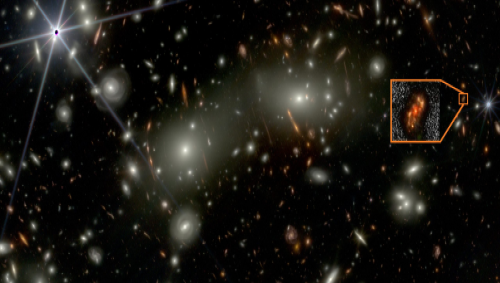
In a landmark achievement for India’s space research community, a team of Indian astronomers has identified a rare 11-billion-year-old spiral galaxy in the distant universe, using data from the James Webb Space Telescope (JWST). The newly discovered galaxy has been named “Alaknanda”, inspired by the sacred Himalayan river — symbolizing purity, continuity, and cosmic flow.
Located nearly 11 billion light-years away, the Alaknanda Galaxy has astonished scientists with its striking resemblance to our own Milky Way. What makes this discovery even more exceptional is that such well-formed spiral structures were not expected to exist so early in the universe’s history. Spiral galaxies are typically believed to take billions of years to evolve into stable, defined shapes. Yet Alaknanda challenges this long-held understanding.
Researchers report that the galaxy is undergoing a vigorous phase of star formation, producing new stars at a rate nearly 60 times greater than our Sun per year. This extraordinary activity provides crucial clues about the conditions that shaped the early cosmos and the rapid growth of stellar systems shortly after the Big Bang.
The discovery was made by Indian scientists collaborating across institutes in Bengaluru, Pune, and Delhi, who meticulously analyzed JWST’s high-resolution infrared imagery to confirm the galaxy’s age, structure, and star-forming capability.
Experts say Alaknanda could reshape scientific theories about galaxy evolution, suggesting that the early universe may have been far more organized than previously believed.