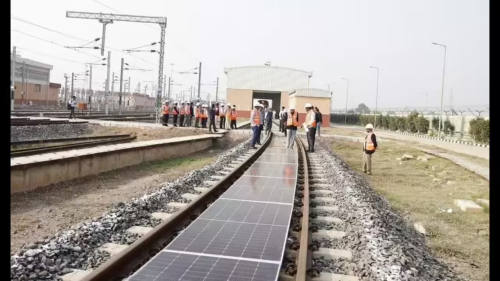
In a landmark push toward clean mobility, India has officially activated its first-ever ‘Solar-On-Track’ system at the Namo Bharat Depot in Ghaziabad — a breakthrough that reimagines how railways can harness renewable energy without needing an inch of additional land.
Developed by the National Capital Region Transport Corporation (NCRTC), the innovation places high-efficiency solar panels directly along the rail corridor, transforming unused trackside spaces into productive power assets. By integrating renewable energy into the railway’s physical backbone, the system represents one of the most practical and scalable examples of green engineering in public transport.
What makes this project groundbreaking is its elegant simplicity. Instead of constructing large solar farms or acquiring fresh land, NCRTC engineers installed the panels along the existing corridor, maximizing space that would otherwise remain idle. This compact setup now feeds clean electricity directly into station operations — powering lighting, signalling systems, and auxiliary services that keep the network running.
Officials say the impact will be profound. Not only does the Solar-On-Track system cut operational dependence on external energy supplies, but it also significantly reduces carbon emissions across the rapidly expanding regional rail network. As India works toward ambitious renewable energy goals, the project provides a model that can be replicated across thousands of kilometres of railway track nationwide.