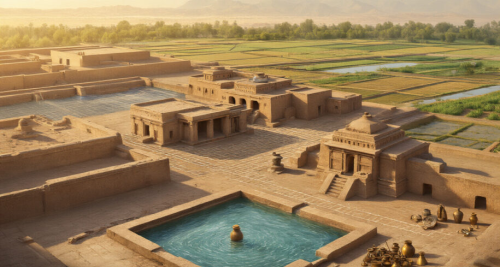
Archaeologists have uncovered evidence of a 5,000-year-old drainage system that showcases the remarkable engineering skills of the Indus Valley Civilization. Sites like Mohenjo-daro and Harappa, located in present-day Pakistan, reveal that this ancient society possessed urban planning expertise far ahead of its time.
The drainage network consisted of covered brick channels, well-connected sewers, and strategically placed soak pits, designed to carry wastewater away from homes and streets. Houses were equipped with private bathrooms, and each unit was connected to the larger citywide system, indicating a high level of civic planning and concern for public hygiene.
Experts note that the scale and sophistication of the drainage system rival, and in some ways surpass, that of many early civilizations. The channels were often made from precisely cut baked bricks and sloped for optimal water flow, reflecting careful calculation and construction.
This discovery underscores the Indus Valley Civilization’s mastery of urban infrastructure, water management, and sanitation—technologies that would not be seen again in many parts of the world for thousands of years. It also offers insight into the daily life of one of history’s earliest urban societies, where planning, health, and civic responsibility were integral to city life.
Historians say these innovations played a crucial role in sustaining large populations in cities that were among the largest settlements of the ancient world. From narrow streets to major public drains, the Indus people demonstrated an understanding of environmental engineering, water conservation, and communal welfare that continues to inspire archaeologists and urban planners today.
This ancient marvel not only highlights the ingenuity of a civilization long gone but also reminds the modern world of the enduring value of smart, sustainable design — a legacy of innovation from more than five millennia ago.