Have you ever wondered how challenging daily life can be for people who cannot speak or hear? For millions who rely on sign language, simple interactions often become barriers. But one young Indian engineer decided to change that narrative.
Priyanjali Gupta, an engineering student from the Vellore Institute of Technology (VIT), Tamil Nadu, has created an innovative AI model capable of recognizing and interpreting sign language gestures. Developed back in 2022, her project has now gained renewed attention for its simplicity, sensitivity, and the powerful impact it promises for inclusive communication.
The inspiration came during a casual conversation at home in Delhi. When Priyanjali’s mother remarked, “These days everyone is creating something new; you’re an engineer—why don’t you try something too?” the offhand comment sparked a transformative idea. Priyanjali realized that devices like Alexa, which respond only to voice commands, offer no utility to those who cannot speak. What if AI could bridge that gap?
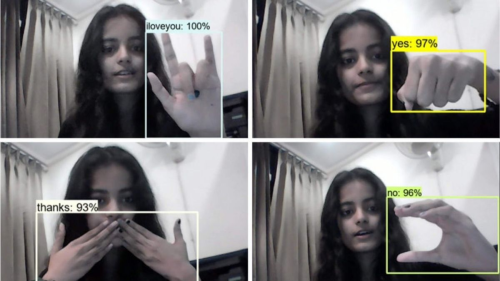
With this question in mind, she built a functional AI system using the TensorFlow Object Detection API, trained to identify six commonly used sign language gestures: “Hello,” “Thank You,” “Please,” “Yes,” “No,” and “I Love You.”
Using a simple camera input, the AI model captures hand movements, interprets them in real time, and produces a meaningful response. The system is lightweight, replicable, and designed to be accessible for widespread use—particularly in assistive technology, smart devices, and inclusive communication tools.
Experts say the project stands out not only for its technical execution but also for its empathy-driven purpose. It reflects how innovation doesn’t always require complex machinery; sometimes it starts with observing everyday problems and caring enough to solve them.
Priyanjali’s work is being celebrated as a perfect blend of compassion, engineering, and social responsibility, offering a glimpse into how AI can be used to create a more inclusive world. By enabling technology to “listen” to those who communicate with their hands, her model sets the stage for future tools that can help millions lead smoother, more connected lives.
As global interest in AI-assisted communication grows, this student-led breakthrough from India stands as a reminder: the world can be transformed not only through genius, but through empathy—and the courage to imagine solutions for those who are too often unheard.