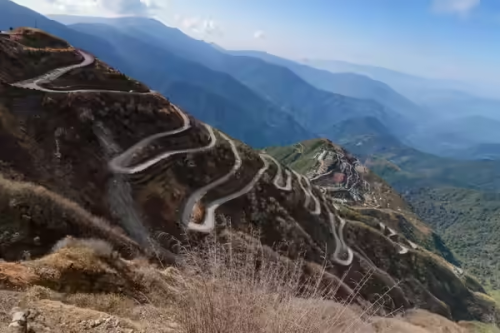
High in the Wuling Mountains of Chongqing, a road clings to the cliffs with a determination as unforgiving as the landscape itself. Built not for comfort but for survival, this razor-thin mountain roadway has become an essential lifeline for remote villages that once had no safe passage in or out of the region. Before its construction, residents relied on perilous footpaths carved naturally by time and erosion — narrow trails that could vanish instantly under rain, fog, fallen rock, or the darkness of night.
Recognizing the urgent need for safer access, Chinese engineers undertook one of the country’s most demanding infrastructure challenges: carving a road directly into nearly vertical stone. Using reinforced retaining walls, deep anchor systems, and specialized rock-support techniques, the route was engineered to withstand landslides, violent storms, and the freeze–thaw cycles that frequently destroy weaker mountain roads.
Even today, the danger remains a constant companion. The lanes are barely wide enough for vehicles, the cliffs plunge hundreds of meters below, and sudden fog can erase visibility in moments. Every bend requires unwavering concentration. There are no wide shoulders, no room for error — only raw rock on one side and open air on the other.
Yet for the people who rely on it daily, this road is not an extreme tourist attraction or an engineering marvel to admire from afar; it is a lifeline. It connects families to hospitals, children to schools, farmers to markets, and entire communities to the modern world. Without it, countless villages would remain cut off and vulnerable.
China has constructed many extraordinary mountain roads across its vast terrain, but few embody the same blend of necessity, bravery, and innovation as this cliffside artery in Chongqing — a reminder that the most dangerous roads are often the ones that matter most.