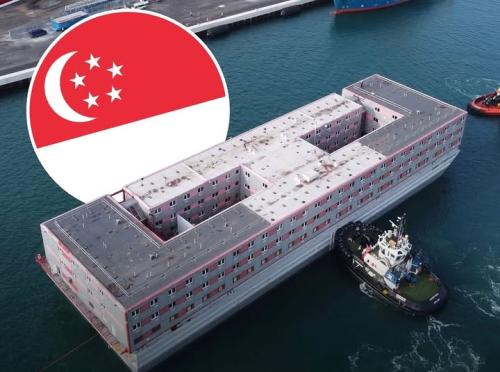
Singapore, long known for its pioneering urban solutions, is once again reshaping global imagination with its newest innovation — the world’s first floating prison, a state-of-the-art correctional facility anchored roughly 500 meters offshore. With land scarcity posing ongoing challenges for the island nation, this bold initiative represents a dramatic shift in how modern societies can rethink incarceration, space usage, and rehabilitation.
The floating complex — engineered like a fortified maritime megastructure — can house more than 2,000 inmates, making it one of the largest correctional environments ever built on water. But what sets it apart is not just its location, but the sweeping technological and humanitarian vision behind it.
At the core of the prison’s operations lies a next-generation security ecosystem, featuring:
AI-driven surveillance networks capable of predictive monitoring
Biometric access controls replacing conventional keys and locks
Autonomous robotic patrol units navigating hallways and decks
Virtual geofencing instead of steel bars, tracking inmate movement with precision
Despite this high-tech backbone, the facility focuses heavily on rehabilitation over punishment. Education centers, digital classrooms, vocational workshops, and counseling spaces are built directly into the structure — offering inmates pathways to reintegration and personal growth. Programs emphasize practical skills, mental well-being, and digital literacy, reflecting Singapore’s belief that meaningful reform starts with opportunity, not confinement.
In a city-state where land is among the world’s most valuable resources, moving a correctional facility offshore is both a strategic necessity and an architectural breakthrough. The floating prison uses renewable energy, seawater desalination, and waste-recycling systems to operate sustainably with minimal environmental impact.
Experts say the project could set a global precedent, inspiring other densely populated nations to explore maritime solutions for infrastructure challenges. Urban planners, criminologists, and policymakers worldwide are already studying Singapore’s model as a potential blueprint for the future.
With this initiative, Singapore is signaling a clear message: innovation is not just about technology — it’s about reimagining systems for a safer, more humane, and more sustainable tomorrow.