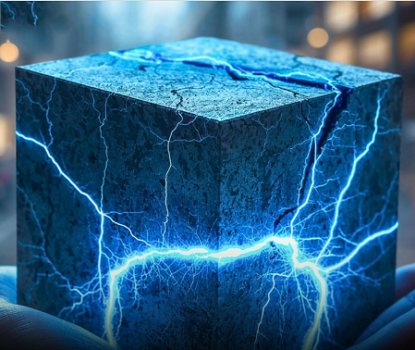
The future of self-powered, sustainable infrastructure has arrived. Researchers at Southeast University in China, led by Professor Zhou Yang, have unveiled a groundbreaking new cement-based material that can generate and store electricity simply by converting the heat difference between a building’s interior and the environment.
This bio-inspired material transforms ordinary building structures into active power sources, potentially enabling “self-powered buildings” and smart city infrastructure.
The novel material is a cement-hydrogel composite that dramatically enhances the material’s thermoelectric effect—the process of converting temperature differences directly into electrical energy.
- Inspired by Nature: The researchers mimicked the layered structure of plant stems, which efficiently transport fluids and nutrients. This led them to design a multilayered composite of alternating cement and hydrogel (specifically, polyvinyl alcohol or PVA hydrogel) layers.
- Ion Mobility Boost: In conventional cement, this heat-to-electricity process (driven by the movement of charged particles called ions) is too weak to be useful. The hydrogel layers, however, create “highways” for ions to move quickly, significantly boosting performance.
- Record Efficiency: The new composite achieved a Seebeck coefficient (
), a measure of thermoelectric efficiency, which is reported to be up to ten times higher than previous cement-based thermoelectric materials.
This innovation goes beyond simply generating electricity; the material is also capable of storing energy, effectively turning the concrete structure into a functional, integrated battery.
This dual capability could have immediate applications in:
- Smart Infrastructure: Powering embedded sensors, wireless communication devices, and monitoring systems in buildings, roads, and bridges without the need for external batteries or power cables.
- Sustainable Cities: Harnessing ambient and waste heat—especially in areas with large temperature swings—to reduce dependence on fossil fuels and lower the carbon footprint of construction.
While the technology is currently in the experimental phase, experts believe this bio-inspired “smart cement” represents a major leap toward more autonomous, resilient, and energy-efficient urban development.