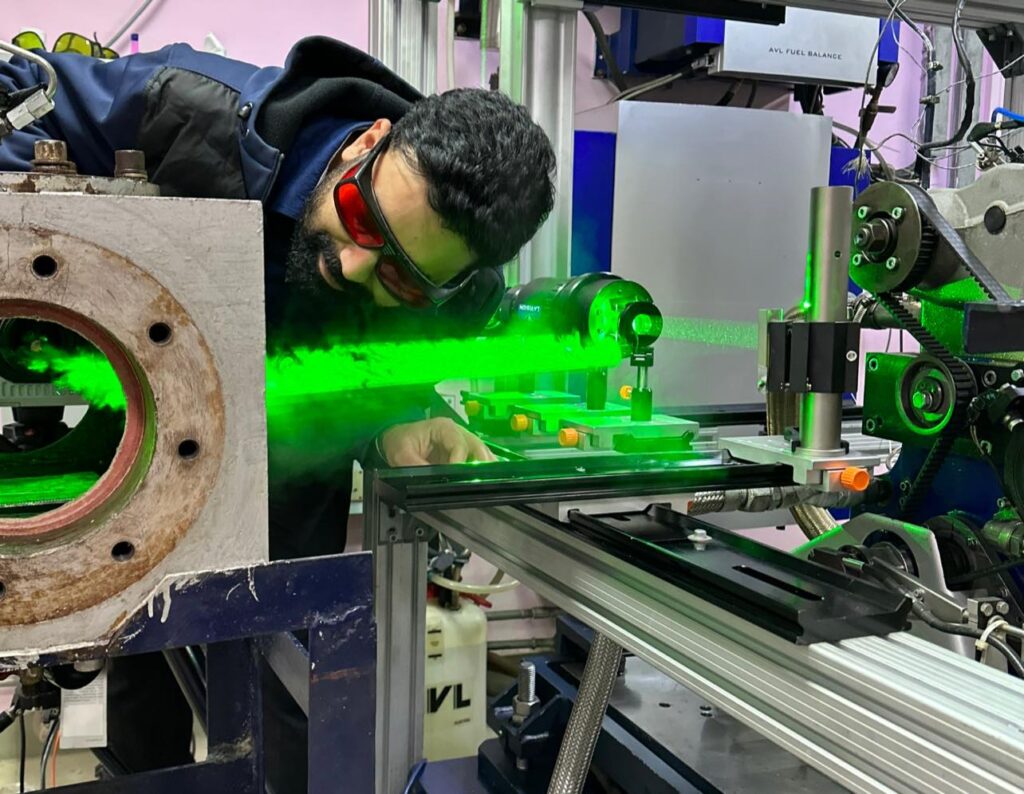
In a landmark scientific breakthrough, an Indian-origin scientist, Dr. Yogeshwar Nath Mishra, has co-developed the world’s fastest microscope, capable of capturing events at an astonishing speed of 125 billion frames per second (FPS)—a feat that effectively allows researchers to “freeze time” and observe ultra-fast molecular and atomic processes in real time.
The revolutionary microscope, known as CUP2AI (Compressed Ultrafast Polarised Planar Imaging), is the first of its kind to record such high-speed dynamic events across large fields without disrupting the natural environment of the sample. It allows for real-time, wide-field imaging of molecular interactions and physical phenomena with unparalleled speed and resolution.
Dr. Mishra, a scientist affiliated with IIT Jodhpur and NASA-Caltech, led this innovation in collaboration with international teams from Germany and the United States. The CUP2AI microscope uses ultrafast lasers, a streak camera, and AI-powered reconstruction algorithms to visualize molecular dynamics at the nanoscale without requiring invasive techniques like staining or vacuum chambers.
Biomedical Research: Real-time observation of protein folding and drug interactions.
Nanotechnology: Monitoring self-assembly of nanoparticles.
Combustion & Climate Science: Tracking soot particle formation in atmospheric research.
“This microscope is like a time machine for science. We can now see things that were once considered invisible due to their speed and scale,” said Dr. Mishra. “This will open new doors in fundamental science and applied research.”
The innovation has been hailed as a game-changer in microscopy, with potential to revolutionize fields ranging from cancer research and virology to environmental science and quantum physics.
India’s scientific community has lauded Dr. Mishra’s contribution as a proud moment for the nation, proving once again the global impact of Indian minds in pushing the frontiers of science and technology.