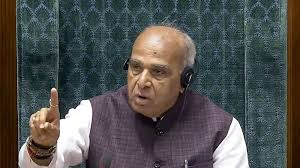
- Political Instability: Uttar Pradesh was experiencing significant political turmoil in the late 1990s, marked by frequent shifts in government, due to fractured mandates and the challenges of coalition politics.
- Kalyan Singh’s Government: Kalyan Singh, the Chief Minister from the Bharatiya Janata Party (BJP), was facing growing opposition and challenges to his leadership, leading to a political crisis.
- Governor’s Intervention: In the midst of this, Romesh Bhandari, the Governor of Uttar Pradesh, dismissed Kalyan Singh’s government and appointed Jagdambika Pal as the Chief Minister on 21 February 1998.
- Judicial Intervention: The political situation took a dramatic turn when the Allahabad High Court intervened the very next day, reinstating Kalyan Singh as Chief Minister.
- End of Jagdambika Pal’s Tenure: As a result, Jagdambika Pal’s tenure as Chief Minister lasted only 24 hours, earning him the distinctiJon of being a one-day Chief Minister in the history of Uttar Pradesh.
- Political Instability: The crisis surrounding Harish Rawat’s leadership in Uttarakhand was triggered by a rebel faction within his own Congress Party and accusations of horse-trading.
- President’s Rule: On 27 March 2016, after the political situation escalated, President’s Rule was imposed in Uttarakhand to dissolve the assembly and manage the crisis.
- Supreme Court Directive: Following a directive from the Supreme Court, Harish Rawat was reinstated as Chief Minister on 21 April 2016, but his task was to prove his majority in the state assembly.
- Failure to Prove Majority: On the day of the floor test, Harish Rawat’s government failed to win the majority, and thus his term as Chief Minister ended after just one day.
- Political and Judicial Dynamics: This episode highlighted the complex interplay of state politics, coalition politics, and the role of judicial intervention in resolving disputes.
- Volatility of Coalition Politics: These brief tenures of Chief Ministers underscore the instability of coalition politics in India, where political alignments can shift rapidly, leading to sudden changes in governance.
- Judicial Role in Political Disputes: The intervention of the judiciary—through the Allahabad High Court in Uttar Pradesh and the Supreme Court in Uttarakhand—illustrates the critical role the judiciary plays in maintaining the constitutional balance during political crises, ensuring that the democratic processes are followed.
- Constitutional Importance: These incidents emphasize the importance of adhering to constitutional norms and procedures, even in times of political turmoil, to ensure that democratic values are upheld.
- Political Instability and Governance: Both cases are reminders of how political instability, within party factions and coalitions, can affect governance and lead to rapid changes in leadership, sometimes in dramatic and unprecedented ways.
Jagdambika Pal’s one-day tenure as Chief Minister of Uttar Pradesh and Harish Rawat’s brief second term as Chief Minister of Uttarakhand underscore the fragility and instability inherent in Indian coalition politics. They also highlight the role of judicial intervention in resolving political crises and ensuring the continuation of democratic processes, even during periods of political uncertainty. These instances stand as stark reminders of the complexities of governance in a multi-party political system and the necessity of adhering to constitutional procedures.