The Karla Caves, located near Lonavala, in Maharashtra, are a significant historical and archaeological site that is home to one of the most impressive and largest Buddhist prayer halls (chaityas). These caves, dating back to around the 2nd century BCE to the 5th century CE, are considered to be one of the oldest and best-preserved rock-cut structures in India.
- The Karla Caves are best known for housing the largest known chaitya cave in India. This cave, also referred to as the Chaitya Griha, is an excellent example of Buddhist architecture and sculpture.
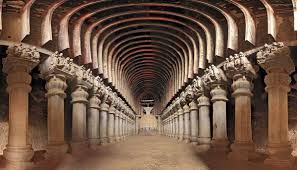
- The dimensions of the prayer hall are 37 meters (121 feet 5 inches) in length, 14 meters (46 feet) in width, and 14 meters (46 feet) in height, making it one of the grandest rock-cut structures of its kind in India.
- The chaitya hall consists of a central columned hall with a high vaulted ceiling, supported by pillars. It was designed for prayer and meditation, and the hall has a stupa (relic chamber) at the far end, which once housed a Buddha statue or relics of the Buddha.
- The design of the chaitya hall includes intricate carvings and reliefs on the pillars and walls, depicting various Buddhist deities and scenes from the life of the Buddha.
- The Karla Caves belong to a group of ancient Buddhist caves that were carved into the rock during the period when Buddhism was flourishing in India, particularly under the Maurya and Satavahana dynasties. They are a significant site for understanding the development of early Buddhist architecture and art.
- The caves were used by Buddhist monks as viharas (monastic dwellings) and chaityas (prayer halls) for meditation, study, and religious rituals.
- The inscriptions found in the caves, written in Brahmi script, suggest that the caves were dedicated to Buddhist religious practices and were likely associated with Buddhist patrons, including wealthy merchants and kings.
- The entrance to the Karla Caves features a monumental arched doorway adorned with carved decorations. The doorway and the entire cave complex exhibit a distinct Buddhist style that combines elements of Mauryan and Satavahana architecture.
- The walls and pillars of the chaitya hall are decorated with intricate carvings of Buddhist motifs, including figures of gods, animals, and Buddha images. The craftsmanship in these carvings reveals the skill of the artisans who worked on the caves, making it a significant example of ancient Indian art.
- The ceiling of the chaitya hall is especially remarkable, with a vaulted structure that was carved from solid rock. The ceiling was designed to resemble a wooden roof with curved beams, showcasing the advanced engineering techniques of the time.
- In addition to the chaitya hall, the Karla Caves complex also includes a number of vihara caves or monastic cells. These were used by Buddhist monks as living quarters during their periods of meditation and study.
- The viharas are relatively simple structures, with stone beds carved into the walls, providing evidence of the austere lifestyle led by the monks.
- Some of the viharas also feature inscriptions and paintings that offer insight into the lives of the Buddhist community during that time.
- The Karla Caves are an important site for the study of Buddhist culture in ancient India, particularly because they reflect the evolution of Buddhist monasticism and architecture. The caves are also closely associated with the Satavahana period, when Buddhism flourished as a state-supported religion.
- The stupa within the chaitya hall signifies the relic worship central to early Buddhist practices, and the caves served as places for communal prayer, meditation, and the worship of the Buddha and Buddhist ideals.
- The Karla Caves are a popular tourist destination and are located about 10 km (6.2 miles) from Lonavala, a hill station in Maharashtra, and can be reached via a trek up the hill or by road.
- The caves are maintained by the Archaeological Survey of India (ASI), and visitors can explore the main chaitya hall, the surrounding viharas, and the beautifully sculpted facades.
- The Karla Caves, along with the nearby Bhaja Caves and Elephanta Caves, are part of a UNESCO World Heritage route for rock-cut Buddhist architecture and are considered important religious, cultural, and architectural landmarks.
The Karla Caves stand as a monumental testament to the artistic and religious achievements of ancient India. The Chaitya Hall within the caves is not only the largest of its kind in India but also serves as a significant example of early Buddhist architecture and the use of rock-cut structures for religious purposes. The intricate carvings, architectural design, and historical inscriptions make the Karla Caves an essential stop for those interested in exploring India’s rich Buddhist heritage and its contribution to ancient architecture and art.