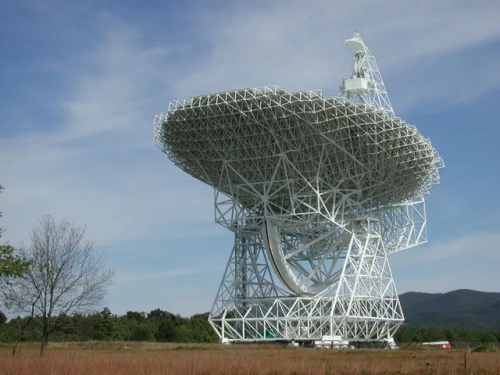
World’s Largest Fully Steerable Radio Telescope, a monumental scientific instrument that has been revolutionizing astronomy and radio science since its completion in 1972. Operated by the Max Planck Institute for Radio Astronomy, this massive telescope combines cutting-edge engineering with the quest to explore the universe.
The telescope boasts a 100-meter diameter parabolic dish, capable of being fully steered to track celestial objects across the sky. Its size and maneuverability allow astronomers to observe distant galaxies, pulsars, quasars, and interstellar phenomena with unparalleled sensitivity. The fully steerable design differentiates it from fixed-dish telescopes, providing greater flexibility for scientific research.
Construction required sophisticated engineering to support the enormous weight of the dish while enabling precise movement and rotation. Advanced motors, structural supports, and computer-controlled systems allow the telescope to maintain alignment while scanning the heavens.
The Effelsberg Radio Telescope has contributed to groundbreaking discoveries in astrophysics, including studies of pulsars, molecular clouds, and interstellar magnetic fields. It is also used for very long baseline interferometry (VLBI), combining signals with other radio telescopes worldwide to create images with extraordinary resolution.
Recognized globally as a world record holder, the Effelsberg telescope is both a technological marvel and a symbol of human curiosity and ingenuity. It attracts researchers, engineers, and astronomy enthusiasts, demonstrating how monumental infrastructure can advance our understanding of the universe.
Standing as a testament to precision engineering and scientific ambition, the World’s Largest Fully Steerable Radio Telescope continues to push the boundaries of human knowledge while connecting the Earth to the farthest reaches of space.