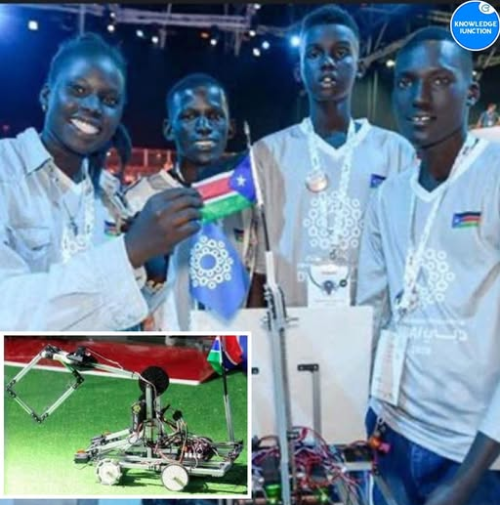
A group of talented teenagers from South Sudan, including Adau Deng Kuol and James Madut, has captured global attention by creating an innovative robot designed to help clean plastic waste from water bodies. Their robot, named Ramceil Botics, was showcased at the prestigious First Global Challenge held in Dubai, one of the world’s largest international robotics competitions.
The First Global Challenge brought together nearly 1,500 students from 191 countries, providing a global platform for young innovators to present technology-driven solutions to real-world problems. Competing on this international stage, the South Sudanese team stood out with their clear focus on environmental protection and sustainability.
Ramceil Botics is specifically designed to collect plastic waste from rivers and waterways, with a vision to eventually help clean major rivers such as the Nile, which is considered one of the largest contributors to plastic pollution entering the oceans. The students said their inspiration came from witnessing pollution firsthand and wanting to use science and engineering to protect natural resources.
Through determination, creativity, and teamwork, the team won their individual match at the competition, marking a significant achievement for young innovators from a country with limited access to advanced technological resources. Their success demonstrated that innovation is not defined by geography, but by ideas and commitment.
James Madut shared that the most important lesson he gained from the competition was the power of teamwork, explaining that collaboration and trust were key to overcoming challenges. Adau Deng Kuol added that the First Global Challenge gave young people a global voice, proving that youth can play a meaningful role in solving environmental and social problems.
Their achievement has been widely praised as a symbol of hope and potential for South Sudan’s youth. Educators and environmental advocates alike see Ramceil Botics as an example of how science, technology, and education can empower the next generation to address global challenges such as plastic pollution.