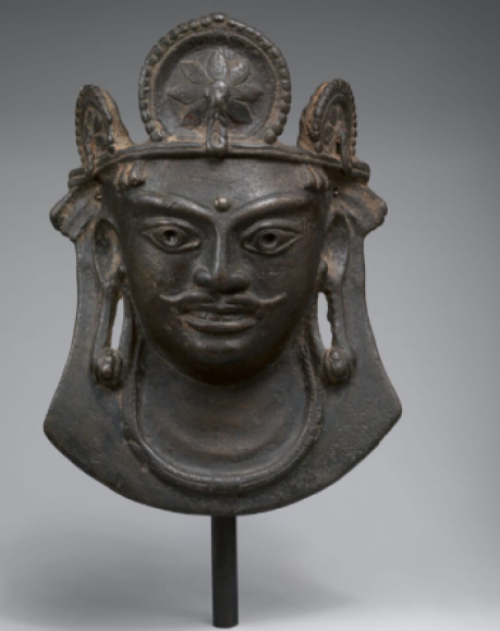
A rare Kalabhairava mask from ancient Kashmir, dating back to the 6th–7th century CE, stands as a powerful testament to early India’s spiritual depth and artistic excellence. Representing Kalabhairava — the fierce manifestation of Lord Shiva — the mask embodies concepts of time, protection, destruction of evil, and cosmic balance, central themes in Shaivite philosophy.
Crafted from copper alloy, the mask reflects the advanced metallurgical skills and refined aesthetic sensibilities of early Kashmiri artisans. The intense facial expression, pronounced eyes, and commanding features are designed not merely as decoration, but as a sacred object intended to inspire reverence and awe. Such masks were often associated with ritual worship and temple traditions, where Kalabhairava was venerated as a guardian deity.
Kalabhairava holds a unique place in Hindu belief as the lord of time (Kala) and the protector of sacred spaces. His imagery symbolizes the unstoppable force of time and the moral order that governs the universe. The presence of this mask highlights the strong Shaivite traditions that flourished in Kashmir during the early medieval period, when the region was a major center of learning, spirituality, and art.
The artwork also provides valuable insight into Kashmir’s cultural history before centuries of political and social change reshaped the region. Objects like this mask serve as visual records of a vibrant civilization where religion, craftsmanship, and philosophy were deeply intertwined.