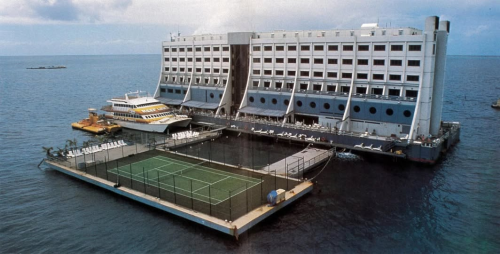
The world’s first floating hotel — a seven-storey marvel once hailed as the future of luxury tourism — has had one of the most extraordinary journeys in modern architectural history. Opened in 1988 on Australia’s John Brewer Reef, the ambitious structure was designed as a fully floating resort complete with restaurants, bars, a nightclub, a tennis court, and panoramic ocean views directly above the Great Barrier Reef. It was a technical and tourism milestone, standing as a symbol of futuristic hospitality on the water.
But reality proved far tougher than the vision. Harsh seas, unpredictable weather, high maintenance costs, and the logistical challenges of running a full-scale resort far offshore quickly turned the project into a financial burden. After struggling to stay afloat — both physically and economically — the hotel was eventually sold and moved across continents.
Its next chapter began in Ho Chi Minh City, Vietnam, where it operated as the Saigon Floating Hotel, becoming a popular nightlife hub on the Saigon River through the 1990s. Yet even there, sustainability issues and rising expenses forced another relocation.
In a move few could have predicted, the structure was purchased by North Korea and transported to Mount Kumgang, where it reopened as Hotel Haegumgang. Once envisioned as a symbol of inter-Korean tourism cooperation, the hotel shut down in 2008 after political tensions halted all joint travel programs. For more than a decade, it remained untouched — a ghost hotel floating in silence.
In 2019, North Korean authorities reportedly ordered the structure to be dismantled, bringing an end to the hotel’s extraordinary 30-year odyssey. From a luxury reef resort in Australia to a river landmark in Vietnam and finally to a politically sensitive site in North Korea, the floating hotel’s story remains one of the most unusual sagas in global tourism — a reminder of how ambitious engineering can drift across borders, cultures, and histories before reaching its final shore.