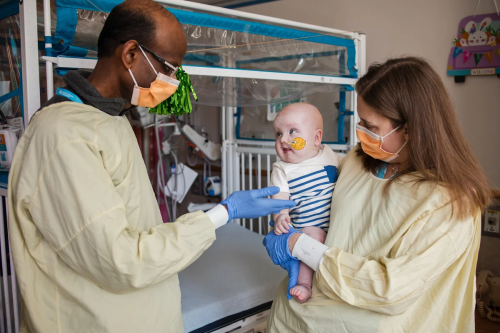
In a milestone that marks one of the greatest medical breakthroughs of the 21st century, a nine-month-old baby from Philadelphia — known publicly as KJ — has become the first human in history to have his DNA rewritten while still alive. His case has stunned the global medical community, proving that fully personalized gene therapy can be developed, approved, and successfully delivered in a matter of months.
KJ was born with a rare and devastating genetic error — a single letter out of three billion DNA pairs was wrong, crippling his liver’s ability to process ammonia. Each time he ate, ammonia built up rapidly in his bloodstream, reaching his brain and threatening to cause irreversible damage or death. Traditional treatments offered no sustainable solution, and his future appeared bleak.
In a desperate and unprecedented effort, doctors turned to CRISPR genome editing, using it with surgical precision like a “genetic GPS.” Scientists identified the exact faulty letter in his DNA, cut it out, and replaced it with a healthy sequence. The entire therapy — designed specifically for KJ and never tested on any other human — was developed in just six months and received ultra-fast emergency authorization from the U.S. FDA in only one week.
At six months old, the treatment was infused into KJ’s bloodstream. The engineered molecules traveled to his liver, located the broken gene, and rewrote his DNA from the inside. Against all odds, it worked. Today, KJ can eat normally, his ammonia levels remain stable, and he is hitting milestones doctors believed were impossible — sitting up, rolling over, and developing like a healthy child.
This extraordinary achievement represents the dawn of a new era where one patient, one mutation, and one customized cure could become standard practice. KJ’s story is not science fiction — it is the future of medicine unfolding in real time, and a powerful reminder of how rapidly personalized genetic therapies are transforming human health.