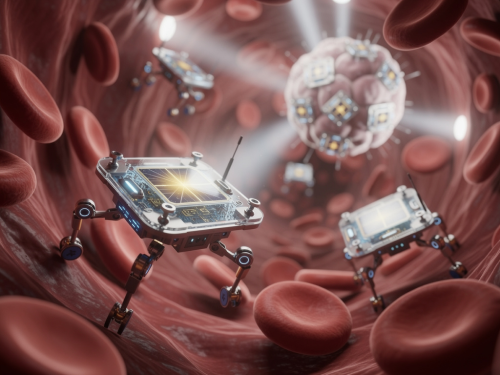
In a groundbreaking scientific achievement, American researchers have developed a micro-robot smaller than a grain of salt, measuring less than one millimeter in size. Despite being 100 times smaller than conventional robots, this tiny marvel is remarkably powerful, equipped with its own solar cells, micro-computer, and sensors, giving it the ability to sense its environment, process information, and perform tasks autonomously.
The creation of this micro-robot addresses a decades-old technological challenge that has puzzled engineers and scientists for over 40 years. By miniaturizing robotics to such an extreme scale without compromising functionality, researchers have opened the door to possibilities previously confined to science fiction.
One of the most exciting applications lies in the field of medicine. These micro-robots could one day navigate through the human body to deliver medication with extreme precision, target blockages in blood vessels, repair tissue, or even assist in minimally invasive surgical procedures. Such capabilities have the potential to reduce the need for traditional surgeries, lower risks of complications, and dramatically improve patient outcomes.
Experts believe that beyond medicine, these tiny robots could be deployed for environmental monitoring, industrial inspections, and advanced research applications, thanks to their unique ability to operate in confined spaces and challenging environments where larger machines cannot reach.
The research team emphasized that while the robot is still in the experimental phase, its successful development marks a turning point in micro-robotics, signaling a future where machines at microscopic scales can interact intelligently with their surroundings. The integration of sensing, computation, and power in such a small package represents a technological milestone that could transform healthcare, engineering, and countless other industries.