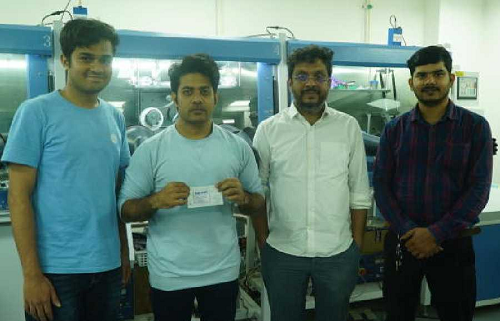
In a breakthrough that could reshape India’s clean energy and electric vehicle (EV) ecosystem, scientists at the Research Institute for Sustainable Energy (RISE) under TCG-CREST have developed an indigenous sodium-ion (Na-ion) battery capable of charging up to 94% in just five minutes — while matching, and in some parameters surpassing, the performance of conventional lithium-ion (Li-ion) batteries.
Developed at the Salt Lake campus of TCG-CREST, a deemed university under The Chatterjee Group (TCG), the new Na-ion technology uses no cobalt, nickel, copper, or lithium, eliminating India’s dependence on globally constrained raw materials. The breakthrough positions the country to reduce its exposure to volatile international supply chains for critical minerals.
According to the institute, the prototype could be ready for industrial-scale commercialisation within two to three years, depending on the establishment of a local supply chain. The investment required to scale up production is estimated at $10–12 billion.
Indian Innovation, Global Potential
Abhik Banerjee, team leader at RISE, said the team successfully engineered Na-ion pouch cells with energy densities of 180 Wh/kg (gravimetric) and 550 Wh/L (volumetric) — outperforming most lithium iron phosphate (LFP) batteries currently deployed in EVs and grid storage systems worldwide.
“These pouch cells use only earth-abundant, non-toxic materials, are easy to manufacture, and can withstand thousands of cycles with minimal degradation,” Banerjee said. “The five-minute charging capability combined with a high-power output of 10 kW means this chemistry can serve everything from electric vehicles to renewable energy grids. This is an Indian technology built for Indian conditions — robust, affordable, and globally competitive.”
Banerjee, who has over 15 years of experience in energy storage research, declined to disclose the exact compounds used in the cells, citing trade confidentiality, but confirmed that all materials are available within India.
Commercialisation Path and Industry Support
The Chatterjee Group, which also owns Haldia Petrochemicals, MCPI, and Garden Silk Mills, is expected to back the commercial rollout of the Na-ion technology. Sources indicate that the group may focus primarily on manufacturing battery cells, the most critical component in battery production. Currently, a majority of Li-ion cells used in India are imported from China.
Banerjee noted that achieving Li-ion–equivalent energy density had long been the biggest challenge for sodium-based batteries. “At RISE, we’ve been able to close that gap,” he said. “In the next two years, our goal is to build larger-format cells with even higher energy density and cycle life.”
If successful, this innovation could establish India as a global leader in sodium-ion battery manufacturing, offering a cost-effective, fast-charging, and environmentally sustainable alternative to Li-ion systems — while paving the way for a homegrown energy storage revolution.