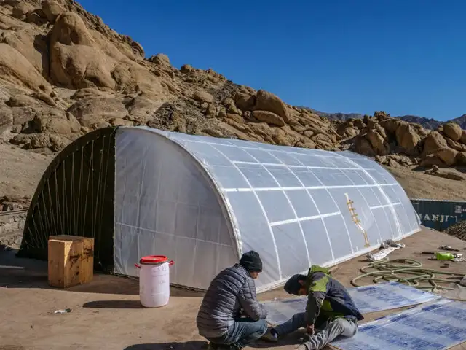
In a groundbreaking move to provide relief to Indian soldiers stationed in the sub-zero temperatures of high-altitude regions like the Galwan Valley and Siachen Glacier, famed Ladakhi engineer, educator, and innovator Sonam Wangchuk—the real-life inspiration for the “Phunsukh Wangdu” character in the film 3 Idiots—has invented a revolutionary solar-heated military tent.
This state-of-the-art, fully portable shelter is designed to leverage solar energy to maintain a comfortable internal temperature, even when outside temperatures plummet.
The invention, developed by Wangchuk and his team at the Himalayan Institute of Alternatives Ladakh (HIAL), aims to replace the traditional kerosene-based heating systems used by the Army, which are costly, polluting, and logistically challenging.
- Solar Passive Design: The tent is a highly insulated, solar-passive structure. It features a “greenhouse” or solar lounge section at the front to trap solar heat during the day, separated from a sleeping chamber by a heat bank (a thermal mass).
- Extreme Warmth: The prototype successfully demonstrated the ability to maintain a temperature of Celsius inside the sleeping chamber, even when the outside temperature was a chilling Celsius.
- Portability and Logistics: Designed for the rugged terrain of high-altitude areas, the tent is fully portable. It can accommodate 10 jawans and is disassembled into 30 to 40 components, with no single part weighing more than , making it easily carried by soldiers or local porters.
- Eco-Friendly: By relying solely on solar energy, the tent eliminates the use of tons of kerosene, significantly cutting down on costs and the carbon emissions that accelerate pollution and glacier melt in the delicate Himalayan ecosystem.
Wangchuk was reportedly motivated by the difficult conditions faced by approximately 50,000 Indian troops deployed in high-altitude areas during the border stand-offs. Having researched solar-heated houses for over 25 years, he refined an earlier design he had made for nomad shepherds to meet the Army’s specific requirements.
The innovation has been widely lauded as a timely, cost-effective, and environmentally conscious solution for military deployment in one of the coldest inhabited places on Earth.