While the Space Race is famously chronicled by tales of American astronauts and Soviet cosmonauts, an often-overlooked pioneer—a Parisian stray cat named Félicette—made history by becoming the first, and to date, only feline to journey into space.
On October 18, 1963, France etched its name into the annals of space exploration with the successful sub-orbital flight of Félicette. The mission was a pivotal step in the country’s own space program, seeking to understand the effects of microgravity and high atmospheric pressures on the mammalian body before launching human astronauts.
The mission began when the Centre d’Enseignement et de Recherches de Médecine Aéronautique (CERMA) acquired 14 female stray cats from the streets of Paris for rigorous selection and training. The cats were assigned numerical designations (Félicette was known as C341) to prevent emotional attachment by the scientists.
The intensive, two-month training regimen put the felines through the same trials as human aspirants:
- Surgical Implants: All 14 cats had permanent electrodes surgically implanted into their brains to monitor neurological activity throughout the mission.
- G-Force Simulation: They were subjected to punishing spins in a centrifuge to simulate the crushing G-forces of launch and re-entry.
- Confinement Tests: The cats were confined to tight containers for long periods to test their reactions to the cramped conditions of the capsule.
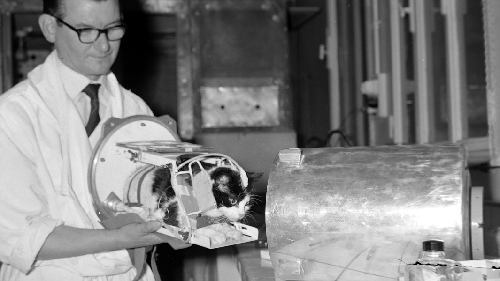
Ultimately, the small, black-and-white “tuxedo” cat C341 was selected. On the morning of October 18, 1963, she was secured in a custom capsule atop a Véronique AG1 sounding rocket and launched from the Interarmy Special Vehicles Test Centre in the Algerian Sahara.
Félicette’s 13-minute suborbital flight was a scientific success. She reached an altitude of 157 kilometers (97 miles), passing the boundary of space, and experienced approximately five minutes of weightlessness. During launch, the cat endured a peak of 9.5 g, almost double the G-forces later experienced by Apollo astronauts heading for the moon. The implanted electrodes successfully transmitted invaluable neurological data back to Earth, confirming the possibility of monitoring brain activity during spaceflight.
The capsule parachuted safely back to Earth, and Félicette was retrieved alive and unharmed, though reportedly shaken. The French media, initially calling the ‘Astro-cat’ “Félix,” soon corrected the name to the feminine Félicette to honor the brave little pioneer.
While her legacy was overshadowed for decades—and sadly, she was euthanized two months after her flight for a post-mortem brain examination—Félicette’s contribution is now being recognized. In 2019, a bronze statue was unveiled at the International Space University in France, forever immortalizing the stray cat who looked up at the stars and made history.