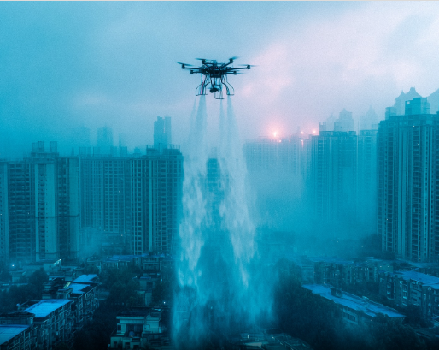
In a significant escalation of its weather modification program, China is utilizing a new fleet of high-tech drones to induce rainfall and combat severe drought conditions across the country. This groundbreaking approach to cloud seeding offers a more precise, efficient, and cost-effective alternative to traditional methods using manned aircraft or ground-based rockets.
The technology, developed by the China Meteorological Administration, involves using specialized drones to disperse tiny particles of silver iodide—a chemical with a crystalline structure similar to ice—into clouds. These particles act as “cloud condensation nuclei,” causing water vapor to condense and form raindrops.
In a recent experiment in the arid Xinjiang region, a fleet of cloud-seeding drones successfully boosted rainfall by over 4% across an area of 8,000 square kilometers in a single day. The operation produced an estimated 70,000 cubic meters of additional rainfall, enough to fill approximately 30 Olympic-sized swimming pools.
This new generation of drones, such as the Wing Loong-2H, offers several advantages. They are capable of flying in complex weather conditions, have a longer endurance than manned aircraft, and can be deployed rapidly to target specific cloud formations. This precision is vital for maximizing the effectiveness of cloud-seeding operations and ensuring that rainfall occurs in the areas where it is most needed, such as agricultural regions and drought-stricken cities.
China has a long history of weather modification, with a comprehensive program that includes a network of ground stations, satellites, and aircraft. The integration of drones is a key step in creating a fully automated, three-dimensional weather modification system that can operate year-round.
While the technology shows immense promise for addressing water scarcity and supporting food security, it also raises ethical and environmental questions. The long-term effects of using chemicals like silver iodide and the potential transboundary implications of a country controlling its weather are subjects of ongoing debate among scientists and international bodies. Despite these concerns, China is pressing ahead, positioning itself as a leader in a new and highly-controversial frontier of climate engineering.