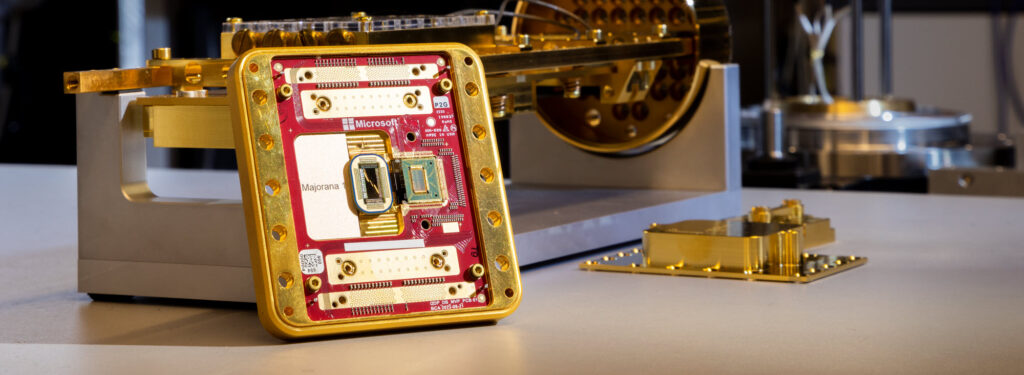
Microsoft today announced a monumental breakthrough in quantum computing with the introduction of Majorana 1, the world’s first quantum chip powered by a novel Topological Core architecture. This innovation, according to Microsoft, is poised to bring about quantum computers capable of solving meaningful, industrial-scale problems in years, not decades.
Majorana 1 leverages the world’s first topoconductor, a revolutionary type of material. This material enables the observation and control of Majorana particles, elusive subatomic particles theorized in the 1930s that act as their own antiparticles. The ability to manipulate these particles is crucial for producing more reliable and scalable qubits – the fundamental building blocks of quantum computers. Unlike traditional bits that are either 0 or 1, qubits can exist in multiple states simultaneously (superposition), significantly enhancing computational power.
Chetan Nayak, a Microsoft technical fellow, emphasized the foundational nature of this invention. “We took a step back and said ‘OK, let’s invent the transistor for the quantum age. What properties does it need to have?’” said Nayak. “And that’s really how we got here – it’s the particular combination, the quality and the important details in our new materials stack that have enabled a new kind of qubit and ultimately our entire architecture.”
Microsoft draws a parallel between the invention of semiconductors, which made modern electronics possible, and the potential impact of topoconductors and the new chip they enable. The company asserts that this technology offers a clear path to developing quantum systems that can scale to a million qubits, allowing them to tackle the most complex industrial and societal challenges.
This announcement marks a significant stride in Microsoft’s long-running pursuit of topological quantum computing, a field that aims to build inherently more stable and error-resistant qubits by leveraging topological states of matter. If successful, Majorana 1 could accelerate the arrival of fault-tolerant quantum computers, opening up new possibilities in fields ranging from pharmaceuticals and materials science to finance and artificial intelligence.