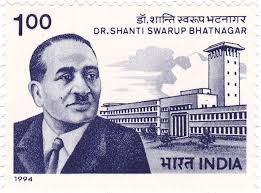
Sir Shanti Swaroop Bhatnagar, a renowned Indian scientist and professor of chemistry, played a pivotal role in establishing national laboratories for scientific research in India.
Proposed the idea of dedicated national laboratories for research in individual scientific fields.
As the first Director-General of the Council of Scientific and Industrial Research (CSIR), he oversaw the establishment of India’s premier research institutions.
- National Physical Laboratory (NPL), Delhi (1947) – Specializes in metrology, material sciences, and precision measurements.
- National Chemical Laboratory (NCL), Pune (1950) – Focuses on chemical and material sciences, polymers, and catalysis.
- National Metallurgical Laboratory (NML), Jamshedpur (1950) – Dedicated to metals, mining, and metallurgy research.
- Central Food Technological Research Institute (CFTRI), Mysuru (1950) – Works on food processing and technology.
- Fuel Research Institute (now Central Institute of Mining and Fuel Research), Dhanbad (1950) – Studies fuel technology and coal research.
Established a strong foundation for scientific research and industrial innovation in India.
Laid the groundwork for technological self-sufficiency in fields like chemistry, physics, metallurgy, and food technology.
His work contributed to India’s post-independence scientific advancements, making the country a leader in applied research and industrial development.
Sir S.S. Bhatnagar is widely regarded as the father of research laboratories in India, and his contributions continue to shape India’s scientific and technological progress.