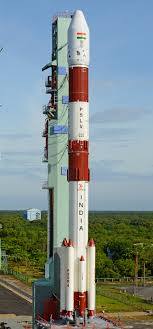
The Polar Satellite Launch Vehicle (PSLV) is India’s most reliable launch vehicle, known for its versatility in deploying satellites into multiple orbits, including Low Earth Orbit (LEO), Sun-Synchronous Orbit (SSO), Geosynchronous Transfer Orbit (GTO), and even interplanetary missions.
First Flight: 20 September 1993 (PSLV-D1, unsuccessful)
First Successful Flight: 15 October 1994 (PSLV-D2)
First Operational Flight: 29 September 1997 (PSLV-C1, launched IRS-1D)
Manufacturer: ISRO (Indian Space Research Organisation)
Height: 44.4 m (145 ft 8 in.)
Lift-off Weight: ~294 tonnes
Stages: Four-stage vehicle (Two solid + Two liquid propellant stages)
Payload Capacity:
Sun-Synchronous Orbit (SSO): ~1,750 kg
Geosynchronous Transfer Orbit (GTO): ~1,410 kg
Low Earth Orbit (LEO): ~3,800 kg
The PSLV uses a four-stage design, alternating between solid and liquid propellants:
- First Stage (PS1 – Solid Rocket Motor)
Propellant: HTPB-based solid propellant
Boosters: Configurations with zero, six, or two strap-on boosters
Primary Thrust Provider for lift-off
- Second Stage (PS2 – Liquid Engine)
Engine: Vikas engine (UDMH + N2O4)
Thrust Control for Stability in atmospheric flight
- Third Stage (PS3 – Solid Rocket Motor)
High-Energy Propellant for Altitude Gain
- Fourth Stage (PS4 – Liquid Engine)
Two Liquid-Fuel Engines for precise orbital injection
Launch Date: 29 September 1997
Launch Vehicle: PSLV-C1
Launch Site: Satish Dhawan Space Centre (SHAR), Sriharikota, Andhra Pradesh
Payload: IRS-1D (Indian Remote Sensing satellite)
Orbit: Polar Sun-Synchronous Orbit (SSO), 740 km altitude
Mission Success: Confirmed PSLV as India’s reliable satellite launcher
India’s workhorse rocket: Used for launching remote sensing, navigation, and communication satellites.
Enabled interplanetary missions: Launched Chandrayaan-1 (2008), Mangalyaan (2013), and Astrosat (2015).
High success rate: Over 50 successful launches since 1994.
Affordable and flexible: Can deploy multiple satellites in one mission.
PSLV has evolved through different versions:
- PSLV-G (Standard version) – Used in initial launches
- PSLV-XL – Uses six large strap-on boosters for higher payloads
- PSLV-CA (Core-Alone) – No strap-on boosters, for lighter payloads
- PSLV-DL, QL, RL – Variants with 2, 4, or 6 boosters, depending on mission needs