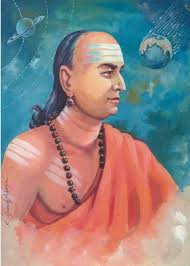
Kelallur Nilakantha Somayaji (1444–1545 CE) was a renowned Kerala school mathematician and astronomer. He made significant contributions to trigonometry, calculus, and infinite series.
In 1502 CE, he wrote “Tantrasangraha,” a Sanskrit mathematical treatise.
He introduced an infinite series expansion for π (pi), which is known today as the Gregory–Leibniz series:
π4=1−13+15−17+19−…\frac{\pi}{4} = 1 – \frac{1}{3} + \frac{1}{5} – \frac{1}{7} + \frac{1}{9} – \dots
This series was later rediscovered by James Gregory (1638–1675) and Gottfried Wilhelm Leibniz (1646–1716) in Europe, about 160 years after Nilakantha.
- Geocentric-Heliocentric Planetary Model
He proposed a partially heliocentric model of planetary motion, where Mercury and Venus revolve around the Sun, while the Sun and other planets revolve around the Earth.
This is similar to Tycho Brahe’s model (proposed a century later).
- Advanced Trigonometry
He refined sine and cosine values and developed improved approximations.
Introduced advanced techniques for solving spherical triangles.
- Astronomical Computations
His methods predicted planetary positions with remarkable accuracy.
Improved calculations related to eclipses and celestial motions.
Kerala School of Mathematics (14th–16th century) was ahead of its time in infinite series, calculus concepts, and trigonometry.
Tantrasangraha’s π series predated European calculus developments by over a century.
His work remains a testament to India’s mathematical heritage and is increasingly recognized in modern history.
Nilakantha Somayaji’s contributions are a remarkable example of India’s rich legacy in mathematics and astronomy!