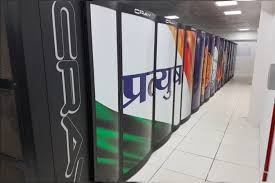
India’s Advancements in Supercomputing: Pratyush, Mihir, and PARAM Siddhi-AI
1. Pratyush and Mihir (2018)
In January 2018, India launched Pratyush and Mihir, significantly enhancing its supercomputing capabilities.
These supercomputers are dedicated to weather and climate research.
Peak Power Output: 6.8 petaflops (1 petaflop = 1 quadrillion floating-point operations per second).
Pratyush – Indian Institute of Tropical Meteorology (IITM), Pune, Maharashtra
Mihir – National Centre for Medium Range Weather Forecasting (NCMRWF), Noida, Uttar Pradesh
Enhanced weather forecasting capabilities, including monsoon prediction.
Improved research in climate modeling and disaster management.
Strengthened India’s position in high-performance computing (HPC).
2. PARAM Siddhi-AI (2020)
Developed under the National Supercomputing Mission (NSM).
Designed by: Centre for Development of Advanced Computing (C-DAC)
Department of Science and Technology (DST)
Ministry of Electronics and Information Technology (MeitY)
Peak Power Output: 6.5 petaflops
Applications:
Healthcare research
Agricultural technology
Cybersecurity
Robotics
Artificial Intelligence (AI)
Ranked 63rd among the world’s most powerful supercomputers in November 2020.
These systems enhanced India’s computational power for scientific research, AI, and climate studies.
Strengthened India’s ability to predict extreme weather events.
Advanced AI-driven research and development in multiple domains.