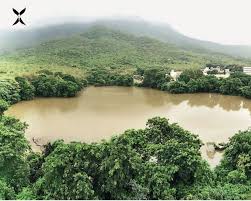
Sudarshan Lake, located at the foot of the Girnar Hills in Junagadh District, Gujarat, is a historically significant reservoir that dates back to the reign of Chandragupta Maurya (c. 321–297 BCE), one of the most notable rulers of ancient India and the founder of the Maurya Empire.
- The lake was initially constructed during the reign of Chandragupta Maurya, and its purpose was likely to provide water for irrigation, as well as for public use in the region.
- The epigraph on the Ashokan pillar, located about a kilometer from the lake, indicates that Emperor Ashoka, Chandragupta’s grandson, undertook the restoration of the lake around 273 BCE. Ashoka is known for his support of public works, including infrastructure such as water management systems.
- The construction and maintenance of large lakes and reservoirs were integral to the urban development and agriculture in ancient India. Sudarshan Lake was part of this tradition, showcasing the engineering and hydraulic expertise of the Mauryan period.
- The Ashokan pillar near the lake not only serves as an inscription but also highlights the importance of the site in the Mauryan Empire’s governance and public welfare.
- The Ashokan inscription near the lake provides vital historical records, including information about Ashoka’s rule and the restoration efforts he made, emphasizing his commitment to improving the lives of his subjects through infrastructure projects.
- Ashoka, after converting to Buddhism, became a patron of peace and welfare, and his efforts to restore Sudarshan Lake were likely part of this broader agenda.
- Today, Sudarshan Lake has significantly shrunk due to the accumulation of silt and debris, which has impacted its original size and functionality.
- Despite the reduction in its size, the historical and cultural significance of the lake remains intact, as it is still linked to the legacy of Chandragupta Maurya and Emperor Ashoka.
- Sudarshan Lake represents an example of ancient hydraulic engineering and urban planning in India. The effort to construct and maintain such a vast water reservoir reflects the Mauryan Empire’s sophistication in managing water resources for both agriculture and urban development.
- The Ashokan pillar stands as a testament to Emperor Ashoka’s focus on public welfare, as well as the ongoing importance of water conservation and management in ancient Indian civilizations.
Though Sudarshan Lake may not be as prominent today due to its shrinking size, its historical relevance continues to be an important marker of ancient Indian engineering, governance, and the legacy of the Maurya Empire.