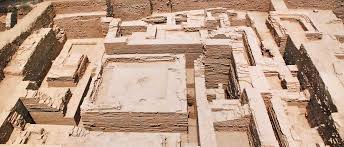
The Harappan civilization’s site at Lothal, located in Gujarat, India, is one of the most significant archaeological finds from the ancient world. It is home to the oldest known dockyard, dating back to 2300 BCE, showcasing the advanced maritime and trade practices of the Indus Valley Civilization.
- The dockyard at Lothal is considered the oldest of its kind, with the dock itself measuring 218 meters long (715 feet) and 37 meters wide (121 feet 5 inches).
- This large dock was specifically designed for the docking of boats and ships, demonstrating the Harappans’ advanced knowledge of maritime technology and trade networks.
- The site’s dockyard reveals that the Harappans had a well-established system for shipping and trade, allowing them to connect with various parts of the ancient world, including the Mesopotamian region.
- Surrounding the settlement is a broad mud-brick embankment, measuring nearly 20 meters wide (65 feet 7 inches), which likely served as a protective barrier against floods or to prevent the intrusion of saltwater into the dock.
- The embankment reflects the Harappans’ engineering capabilities, providing protection for the settlement and its infrastructure.
- The settlement itself measures 230 meters by 170 meters (754 feet 7 inches by 557 feet 9 inches), with the entrance located to the south.
- The town layout suggests organized urban planning, with clearly demarcated areas for residential and industrial purposes.
- The Harappans were known for their extensive trade networks, and Lothal served as a key port town. Boats were docking here as early as 1850 BCE, indicating the site’s long history as a maritime hub.
- The presence of beads, semi-precious stones, and evidence of metalworking points to Lothal’s role as a center for commerce, especially in terms of precious materials and crafts.
- The dockyard is a testament to the engineering expertise of the Harappans, who constructed it with an intricate understanding of water management, ensuring that the dock could handle the flow of water and tides.
- The existence of the dockyard suggests that the Harappans not only had advanced shipbuilding technology but also a comprehensive understanding of navigation and water currents, supporting their trade in goods such as cotton, spices, and textiles.
- Lothal’s Dockyard serves as evidence of the maritime prowess and trade activities of the Harappan Civilization, which was one of the earliest urban cultures in the world.
- The site also highlights the technological sophistication of the Harappans, who were able to build and maintain a functional dockyard for centuries, underscoring their proficiency in civil engineering and environmental management.
- The discovery of Lothal provides insight into the economic importance of the Indus Valley Civilization in connecting South Asia with distant regions, notably the Mesopotamian civilizations, through extensive trade networks via sea routes.
Lothal stands as a key example of the Harappans’ technological and cultural achievements, revealing their mastery in both urban planning and maritime commerce. The site continues to be a rich source of information about one of the most advanced ancient civilizations in the world.