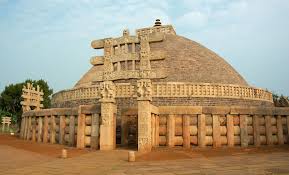
The Great Stupa at Sanchi, located in Madhya Pradesh, is one of the most significant and well-preserved examples of ancient Indian architecture and Buddhist monuments. Initially built by Emperor Ashoka between 273 and 232 BCE, the stupa has undergone several changes and expansions over the centuries.
- The Great Stupa was originally constructed by Emperor Ashoka during his reign in the 3rd century BCE, after his conversion to Buddhism following the Kalinga War. Ashoka is known for promoting Buddhism and constructing numerous stupas, pillars, and edicts throughout the Indian subcontinent.
- The stupa was initially built with bricks, symbolizing a simple yet profound structure for housing relics of the Buddha, in line with the Buddhist tradition of honoring the Buddha’s remains.
- Over time, the stupa was enlarged and enclosed within a stone structure, enhancing its durability and grandeur. The stone walls and the stone railings around the stupa were added during later periods, possibly under the rule of the Shunga dynasty (2nd century BCE).
- The stone structure and decorative elements reflect the architectural evolution in Indian Buddhist art, as well as the growing influence of Buddhist symbolism.
- In its present form, the Great Stupa has an overall diameter of 37 meters (121 feet 5 inches), making it one of the largest and most imposing stupas in India.
- The height of the stupa is 16 meters (52 feet 6 inches), with the central dome serving as a symbol of the cosmic order and the Buddha’s enlightenment.
- The stupa’s massive size and circular shape are significant in Buddhist cosmology, representing the universe and the cycle of birth and rebirth.
- The Great Stupa is not just a physical structure but also a symbolic representation of Buddhist teachings. The dome represents the cosmos, while the four gateways (toranas) surrounding the stupa are adorned with intricate carvings that depict scenes from the Buddha’s life, as well as Jataka tales (stories of the Buddha’s previous lives).
- The railings and carvings also depict symbols associated with Buddhism, such as the wheel of Dharma, which represents the Buddha’s teachings and the path to enlightenment.
- The stone carvings at Sanchi are some of the finest examples of early Indian Buddhist art, with detailed reliefs showcasing not only religious themes but also depictions of the society and culture of that time.
- The toranas (gateways) are particularly famous for their finely sculpted images, illustrating the transition from the more austere early Buddhist art to a more decorative and narrative style.
- The Great Stupa at Sanchi was declared a UNESCO World Heritage Site in 1989, recognizing its cultural, historical, and architectural significance. It remains one of the most visited Buddhist sites in India, attracting pilgrims, scholars, and tourists alike.
- The Great Stupa at Sanchi serves as a symbol of Buddhist heritage and stands as a testament to the religious, cultural, and artistic achievements of ancient India. The site remains one of the oldest and most influential examples of Buddhist architecture in the world.
- It also marks the beginning of a rich tradition of Buddhist architecture that spread across India and beyond to countries like Sri Lanka, Thailand, Nepal, and Southeast Asia, where similar stupas and monuments were built.
The Great Stupa at Sanchi is a profound symbol of spirituality, architecture, and historical continuity, reflecting the enduring legacy of Buddhism in India and its influence on world heritage.