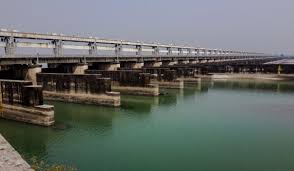
The Farakka Barrage is a crucial infrastructure project on the Ganga River, serving multiple purposes. Here are more detailed aspects of the barrage:
The Farakka Barrage spans 2,245 meters (7,365 feet 6 inches) across the Ganga River.
It comprises 108 gated bays, each 18 meters (59 feet) wide, allowing for precise control of water flow.
Two fish locks, each 8 meters (26 feet) wide, are integrated into the structure to facilitate the passage of fish and other aquatic life, ensuring ecological balance.
The barrage is situated in Murshidabad district, West Bengal, near the town of Farakka.
It is strategically located at the point where the Ganga River splits into the Bhagirathi-Hooghly and the Padma, a distributary flowing into Bangladesh.
The primary purpose of the Farakka Barrage is to divert water into the Bhagirathi-Hooghly River to maintain navigable depths at Kolkata Port, ensuring the port remains operational year-round.
The barrage regulates the distribution of water between India and Bangladesh, as per the Ganges Water Sharing Treaty, ensuring equitable sharing of river waters during lean seasons.
The barrage helps in maintaining the hydrological balance of the region, supporting agriculture, drinking water supply, and industrial uses.
The inclusion of fish locks and careful management of water flow are designed to mitigate the impact on aquatic ecosystems and support biodiversity.
By regulating the flow of the Ganga River, the Farakka Barrage plays a significant role in controlling floods, protecting downstream areas from inundation during heavy monsoon rains.
The barrage supports the regional economy by ensuring the viability of Kolkata Port, a key economic hub for eastern India.
It also aids in irrigation, providing water to vast tracts of agricultural land in West Bengal and neighboring states, enhancing food security and livelihoods.
The barrage has been at the center of environmental and geopolitical discussions. Critics argue that it has led to siltation, affecting the river’s flow and health.
There have been concerns about the impact on agriculture and fisheries, both upstream and downstream, particularly in Bangladesh.
Regular maintenance and modernization efforts are essential to ensure the barrage continues to function effectively. This includes upgrading the gates, fish locks, and other infrastructure to adapt to changing hydrological and environmental conditions.
The Farakka Barrage is a vital component of India’s water management strategy, balancing the needs of navigation, agriculture, flood control, and international water sharing agreements. Its role in supporting the ecological and economic stability of the region highlights its multifaceted importance.