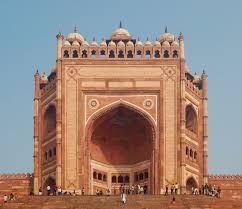
Buland Darwaza is a monumental structure located in Fatehpur Sikri, near Agra in Uttar Pradesh, India. It is renowned as the highest gateway in India and stands as an iconic example of Mughal architecture. Built during the reign of Emperor Akbar (r. 1556–1605), the gate commemorates his military victories and represents the grandeur of the Mughal Empire.
- Buland Darwaza was constructed in 1601 by Emperor Akbar to mark his victory over Ranthambore Fort in Rajasthan and Khandesh, a region in present-day Maharashtra.
- The gate was intended to symbolize the might and supremacy of the Mughal Empire during Akbar’s reign, a time when the empire was at its peak.
- The gateway also signifies Akbar’s success in expanding the Mughal Empire and consolidating his rule in northern India.
- Height: Standing at a towering 53.5 meters (175 feet 6 inches), Buland Darwaza is the tallest gateway in India and one of the largest of its kind in the world.
- Design: The gate is a grand entryway leading to the Jama Masjid (Friday mosque) and the tomb of Sufi saint Salim Chishti in Fatehpur Sikri.
- The gateway is built in a multi-arched design, with a central archway that is larger and more ornate than the others. The arch is flanked by smaller arches, creating a visually striking and symmetrical appearance.
- The structure is primarily made of red sandstone, which was a hallmark of Mughal architecture, and the gateway is embellished with intricate carvings, calligraphy, and decorative motifs.
- The inscription at the top of the gateway features a message from Emperor Akbar, celebrating his military conquests and also emphasizing the importance of justice and governance.
- Buland Darwaza is an example of Mughal architecture, blending Persian, Turkish, and Indian styles. The structure’s design incorporates elements of Islamic architecture, such as the use of arches and domes, along with the rich decoration of Persian-inspired tile work and calligraphy.
- The architectural style combines Islamic and Hindu influences, making it a unique feature of Mughal construction. The gateway is designed to reflect Akbar’s vision of a harmonious and inclusive empire that combined different religious and cultural traditions.
- The chhatri (umbrella-like structure) at the top of the gate provides a beautiful contrast with the intricate design below and adds to the visual splendor of the structure.
The Buland Darwaza features inscriptions in Arabic, which recount Akbar’s victories. One of the inscriptions on the gateway reads:
“The world is a garden and the Sultan is its gardener.”
- The calligraphy highlights Akbar’s belief in his divine right to rule and his recognition of his military prowess. The quotes also serve to elevate the significance of the structure and reinforce Akbar’s authority.
- Fatehpur Sikri, where the Buland Darwaza stands, was the capital of the Mughal Empire from 1571 to 1585 during Akbar’s reign. It was abandoned shortly after Akbar’s reign due to water scarcity, but the Buland Darwaza remains a lasting symbol of that period.
- The gateway is located at the southern entrance to Fatehpur Sikri and serves as the main entry point to the complex of buildings, including the Jama Masjid, the tomb of Salim Chishti, and other historical structures.
- Fatehpur Sikri itself was designed as a symbol of the Mughal Empire’s grandeur, showcasing Akbar’s vision of combining the best of Persian, Indian, and Mughal architectural traditions.
- Buland Darwaza is often seen as a symbol of Akbar’s military might and his ambitions. The gate is designed not just to impress visitors with its size and beauty but to also serve as a physical manifestation of Akbar’s success in expanding the Mughal Empire.
- The triumphal arch symbolizes victory, and the inscriptions on the gateway celebrate not only Akbar’s military conquests but also his spiritual and moral authority as the ruler of the Mughal Empire.
- The massive scale and opulence of the gateway reflect the prosperity and power of the Mughal Empire during its zenith under Akbar.
- Over the years, Buland Darwaza has become an important cultural and historical landmark in India. It is one of the most famous examples of Mughal architecture and attracts thousands of visitors each year.
- The grandeur of the structure and its historical context have made it a subject of study for architects, historians, and tourists alike. It is an iconic feature of Fatehpur Sikri, which is a UNESCO World Heritage site.
- The gateway is often featured in literature, art, and films that explore the Mughal era and the legacy of Akbar’s reign.
- Today, Buland Darwaza remains a key tourist attraction within the Fatehpur Sikri complex. Visitors come to marvel at the gateway’s architectural brilliance and historical significance.
- The structure has been maintained by the Archaeological Survey of India (ASI) to preserve its cultural and historical importance. However, the gateway faces challenges from weathering, and steps are taken to ensure its conservation.
- Buland Darwaza is often compared to similar structures in other parts of the world, such as the Isfahan’s Naghsh-e Jahan Square in Iran, in terms of its monumental scale and artistic elegance.
- The gateway stands out due to its enormous height, making it visible from a great distance within Fatehpur Sikri and adding to its imposing presence.
- The gate is often referred to as the “Gate of Magnificence” due to its majestic appearance.
Buland Darwaza is not just a historical gateway but an enduring symbol of Akbar’s triumphs and the grandeur of the Mughal Empire. Standing as the highest gateway in India, it continues to captivate visitors with its architectural splendor and historical legacy, making it one of the most important cultural landmarks in the country. Its grandeur, design, and inscription ensure that it remains a testament to the power and vision of Emperor Akbar.