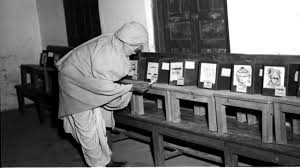
Each candidate in the elections had a separate ballot box, marked with their name and party symbol. Voters would approach the ballot box corresponding to their chosen candidate and cast their vote by dropping a paper slip into it. Managing multiple ballot boxes for each candidate at every polling station was cumbersome.
The process was time-consuming and required significant logistical support to manage and count the votes from numerous boxes. As India’s electorate grew, this system proved to be impractical for large-scale elections.
Voters were provided with a single sheet listing all the candidates contesting the election.
They marked their choice directly on this paper, typically by placing a cross or tick next to the name of their preferred candidate.
After marking their choice, voters would deposit the ballot paper into one central ballot box.
The voting process became more straightforward, reducing confusion for voters.
Counting votes became faster as there was only one type of ballot paper and a single box per polling station.
The new system eliminated the need to manage multiple ballot boxes, significantly easing the logistical challenges for election officials.
The single ballot paper system made elections more organized and less prone to errors. It simplified the administrative process, leading to quicker and more accurate vote counting. As India’s population and voter base continued to expand, the single ballot paper system provided a scalable solution that could handle the increasing number of voters. Introduced in the 1990s, EVMs further streamlined the process by replacing paper ballots with electronic votes.
EVMs enhanced the speed, security, and transparency of elections, making vote counting nearly instantaneous and reducing the scope for manual errors or fraud. The Indian electoral process has seen constant innovation and refinement, with a focus on improving voter experience and ensuring the integrity of elections.
The transition from separate ballot boxes to a single ballot paper system in the 1962 general elections marked a pivotal moment in India’s electoral history. This change not only simplified the voting process but also laid the foundation for future advancements, including the adoption of electronic voting machines. As a result, India’s electoral system has evolved to accommodate the needs of its large and diverse democracy, ensuring efficient, secure, and transparent elections.