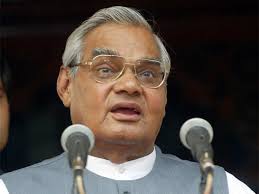
Atal Bihari Vajpayee (1924–2018) was one of India’s most influential and respected political figures, who served as the Prime Minister of India in three terms. Known for his oratory skills, diplomatic prowess, and a deep commitment to democracy, Vajpayee remains a towering figure in Indian politics. Below are further details of his key achievements and contributions.
Born on 25 December 1924 in Gwalior, Madhya Pradesh, Vajpayee began his political journey as a member of the Rashtriya Swayamsevak Sangh (RSS), where he was trained in the ideology of cultural nationalism. His early involvement in politics began with the Bharatiya Jana Sangh (BJS), a political party founded by Dr. Shyama Prasad Mookerjee. Vajpayee rose quickly through the ranks due to his leadership qualities, oratory skills, and strong ideological grounding.
Vajpayee made a historic mark in India’s diplomatic history by delivering speeches in Hindi at the United Nations General Assembly. This was a bold and symbolic move, marking the first time that an Indian leader used Hindi on such a prestigious global platform. His speeches, delivered in 1977 and 1978, were powerful expressions of India’s foreign policy and its pride in its cultural and linguistic heritage.
- First Speech in 1977: Vajpayee was serving as India’s Minister of External Affairs in Prime Minister Morarji Desai’s government. His speech focused on India’s foreign policy stance, and he expressed the country’s commitment to peace, nuclear disarmament, and strengthening the voice of developing nations at the global level. The speech was later translated into English by an Indian diplomat for broader global comprehension.
- Second Speech in 1978: Vajpayee repeated this feat the next year, further solidifying his position as an effective communicator of India’s foreign policy objectives. His Hindi speeches at the United Nations became a source of national pride and are still remembered as a significant moment in India’s diplomatic history.
First Term (1996): Vajpayee was appointed as the 10th Prime Minister of India on 16 May 1996. However, his first term was short-lived, lasting only 13 days. His government was unable to secure a majority in the Lok Sabha (the lower house of Parliament) after the withdrawal of support from coalition partners. Despite the brevity of his first term, Vajpayee’s political maturity and skill in navigating coalition politics were evident even during this short period.
Second Term (1998–2004): Vajpayee returned as Prime Minister in March 1998, after leading his party, the Bharatiya Janata Party (BJP), to a strong electoral victory. His second term, which lasted until May 2004, is considered one of the most impactful in modern Indian history. Some of the major highlights during this period include:
- Pokhran-II Nuclear Tests (1998): Under Vajpayee’s leadership, India conducted nuclear tests at Pokhran in May 1998, officially declaring itself a nuclear power. This bold move was a defining moment of his tenure, showcasing India’s strategic autonomy and technological prowess, despite international pressure and sanctions.
- Lahore Declaration (1999): Vajpayee made a historic visit to Pakistan in 1999, where he met Prime Minister Nawaz Sharif to sign the Lahore Declaration, aimed at improving bilateral relations between the two countries. The visit was seen as a positive step towards peace, though it was soon overshadowed by the Kargil War.
- Kargil War (1999): The Kargil conflict with Pakistan tested Vajpayee’s leadership. Under his guidance, India successfully repelled the Pakistani incursions, and the country’s military prowess and resolve were widely acknowledged. Vajpayee’s handling of the crisis was viewed as a testament to his leadership in difficult times.
- Economic Reforms and Infrastructure Development: Vajpayee’s government focused on boosting India’s economy through a series of reforms, including privatization and liberalization of key sectors. He also initiated the Golden Quadrilateral project, an ambitious infrastructure program to connect major cities in India through highways, which had a lasting impact on India’s transport infrastructure.
Vajpayee’s third term as Prime Minister came to an end in May 2004 after his government lost in the general elections to the Indian National Congress (INC) led United Progressive Alliance (UPA). Despite the defeat, Vajpayee’s contribution to Indian politics was acknowledged by his opponents and admirers alike. He stepped down gracefully after the defeat, with a sense of dignity and respect for the democratic process.
Vajpayee’s political legacy is marked by several significant achievements:
- Leadership and Statesmanship: Known for his oratory skills, Vajpayee was a leader who commanded respect across political lines. His speeches, laced with wisdom, wit, and profound insight, were often seen as a reflection of his statesmanship. He was admired not just in India, but also on the global stage.
- Vision for India: Vajpayee’s vision for India was rooted in development, modernization, and self-reliance. He believed in empowering the common people and laying the foundation for an India that would be recognized as a global power.
- Strengthening Democracy: As a leader, Vajpayee was a staunch believer in democracy, pluralism, and secularism. His efforts to keep the government inclusive and forward-looking made him one of the most respected leaders of his time.
- International Diplomacy: His diplomatic outreach, especially his approach towards Pakistan, was a defining feature of his tenure. Despite the challenges of bilateral relations, he sought peace while maintaining India’s sovereignty.
- Commitment to National Security: The nuclear tests of 1998 and his response to the Kargil War solidified his legacy as a leader who prioritized national security and India’s strategic autonomy.
Vajpayee was known for his charismatic and dignified personality. His leadership style was marked by a blend of firm decision-making and a deep sense of compassion. He was a poet, an orator, and a visionary who understood the importance of both domestic policy and international diplomacy. Vajpayee’s ability to maintain a balance between personal humility and political ambition endeared him to people across India.
Vajpayee retired from active politics in the 2000s due to health issues. He passed away on 16 August 2018, at the age of 93. His passing marked the end of an era in Indian politics, as he was fondly remembered as one of the tallest and most revered political leaders in the history of independent India.
Atal Bihari Vajpayee’s legacy lives on through his speeches, policies, and the impact he had on shaping modern India. He is remembered as a visionary leader, a statesman, and a true democrat, whose contributions continue to shape the political landscape of India even today.