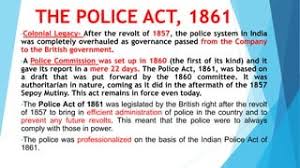
The Police Act of 1861 established a standardized police system across British India. Prior to this, policing was fragmented, with different regions having their own systems of law enforcement.
The Act created a centralized police system that applied uniformly across the country, ensuring consistency in policing procedures and governance.
The Act was introduced after the Indian Rebellion of 1857 (also known as the Indian Mutiny), during which the British authorities faced significant challenges in maintaining law and order.
The British government aimed to strengthen control over India, and the Police Act of 1861 was part of a broader effort to institutionalize policing as a means of ensuring stability and suppressing dissent.
The Act created a hierarchical police system with officers such as inspectors, sub-inspectors, constables, and superintendents.
Police officers were appointed by the British government and had to follow strict rules regarding discipline and behavior.
The police were tasked with maintaining public order, preventing crime, and ensuring the security of British officials and property.
The police force was also given the power to arrest, investigate crimes, and prevent disturbances, often with little regard for civil liberties, particularly when dealing with local populations in the colonies.
The Police Act of 1861 institutionalized the police as an instrument of control in colonial India, often used to suppress political movements and maintain British rule.
It created a top-down, authoritarian system where police had significant powers over local populations with minimal accountability.
The legacy of the Police Act of 1861 continues to influence India’s modern police system, although significant reforms have been made over the years.
After India’s independence in 1947, the Police Act of 1861 continued to be in force for many years.
The Act’s colonial legacy of centralized control and lack of accountability led to calls for reform, with many advocating for changes to modernize the police system and align it with democratic values.
Over time, some provisions of the Police Act were amended, but the overall structure it created continues to form the basis of policing in India.
The Police Act of 1861 was a crucial law that shaped the policing framework in colonial India and laid the foundation for the modern police system in the country.
It introduced a uniform system of policing across British India, but its legacy remains controversial due to its role in maintaining colonial control and suppressing local populations.
Post-independence, India has worked to reform the police system, although the core structure of the Act continues to influence law enforcement practices today.