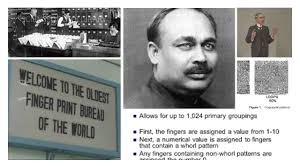
The fingerprint bureau in Calcutta was established by the British colonial government as part of an effort to improve crime detection methods.
The bureau was set up to maintain a database of fingerprints and use them for criminal identification, a technique that was still in its early stages at the time. The science of fingerprint identification, known as dactyloscopy, was in its early stages when the bureau was created.
Dactyloscopy relies on the unique patterns of ridges and furrows found on human fingers, which are distinctive to each individual, even among twins. The role of the fingerprint bureau was to collect, classify, and analyze fingerprints for criminal identification and investigations. One of the first major successes of the fingerprint bureau occurred in 1898 when fingerprints were used to solve a murder case in Jalpaiguri, West Bengal. This case is believed to be one of the earliest instances in the world where a criminal was identified and incriminated based on fingerprints. The use of fingerprints as evidence marked a revolutionary step in criminal justice.
The case demonstrated the potential of fingerprint evidence in providing accurate and irrefutable proof of a suspect’s identity. The establishment of the fingerprint bureau in Calcutta is considered a major milestone in the history of forensic science, as it was the first such bureau in the world. The method of fingerprint identification quickly spread to other parts of the world, and fingerprinting became a standard practice in law enforcement agencies across countries.
The success of fingerprint identification helped establish the importance of scientific techniques in solving crimes and ensuring justice. The fingerprint bureau in Calcutta laid the foundation for modern forensic investigation practices. Today, fingerprint identification remains one of the most reliable and widely used methods of identifying criminals and solving crimes. The Indian Fingerprint Bureau, which evolved from the original bureau in Calcutta, continues to play a crucial role in criminal investigations across India.
The creation of the first fingerprint bureau in Calcutta in 1897, and its use in solving the Jalpaiguri murder case in 1898, marked a significant leap in the application of forensic science to criminal justice. The use of dactyloscopy revolutionized crime-solving, paving the way for modern criminal investigations and establishing India as a pioneer in the field of fingerprint identification.