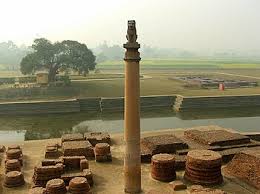
The Stambha (pillar) is one of the most iconic and enduring architectural features of ancient Indian architecture, and the pillars of Emperor Ashoka represent some of the finest examples from this period. The Ashokan pillars were constructed primarily during Emperor Ashoka’s reign (c. 268–232 BCE), after his conversion to Buddhism following the Kalinga War.
The Ashokan pillars were erected by Emperor Ashoka as part of his efforts to spread Buddhism and its teachings throughout his vast empire. These pillars were primarily inscribed with Edicts of Ashoka, which outlined the king’s ethical and moral principles based on Buddhist teachings.
The pillars were not just symbols of royal power but also served as spiritual and political statements, designed to communicate Ashoka’s commitment to non-violence (Ahimsa), dharma (moral law), and the welfare of his people.
The Sarnath Pillar, also known as the Ashoka Pillar of Sarnath, is one of the most famous and important of these pillars. It was erected by Ashoka at Sarnath, near Varanasi (Uttar Pradesh), 26 years after his coronation, around c. 250 BCE.
This pillar marks the site of the Buddha’s first sermon after attaining enlightenment, making it a highly sacred place for Buddhists. The pillar is particularly famous for its lion capital, which has become a symbol of India.
The Sarnath Pillar stands approximately 15 meters (49 feet) tall and is made of polished sandstone, which was quarried from Chunar in Uttar Pradesh.
The pillar itself is a monolithic shaft (a single piece of stone) that is tapered towards the top. The shaft is mounted on a stone base, which features the lion capital at its summit.
The Lion Capital of the Sarnath pillar is one of the most renowned and emblematic images of ancient Indian art, depicting four lions facing in different directions, symbolizing the Buddha’s teachings and the spread of dharma in all directions.
The pillar at Sarnath also bears an inscription, known as the Edict of Ashoka, which conveys the king’s Buddhist-inspired message to his subjects.
The edict speaks of moral and ethical conduct, such as non-violence, respect for life, truthfulness, and tolerance. Ashoka emphasized the importance of treating all living beings with respect and adhering to the path of righteousness (Dharma).
The inscription is written in Prakrit and Brahmi script, an early form of Indian writing, making it one of the earliest and most important examples of written Indian history.
The lion capital at the top of the Sarnath pillar is one of the most significant symbols of Indian culture and Buddhism. The four lions are often interpreted as symbols of strength, courage, and royal authority. They are also associated with the Buddha’s lion’s roar, a metaphor for the proclamation of the Buddha’s teachings to the world.
The wheel (Dharmachakra) placed between the lions on the capital represents the Buddha’s teachings and the spread of Buddhism. The wheel has 24 spokes, which represent the 24 hours of the day and symbolize the constant nature of the wheel of Dharma.
The lotus pedestal beneath the lions is symbolic of purity and spiritual growth.
The Sarnath Pillar is not only a symbol of Ashoka’s rule but also an enduring symbol of Buddhism in India. The Lion Capital of Sarnath has become the national emblem of India, a powerful symbol representing the country’s rich cultural and historical heritage.
The pillars and their inscriptions are crucial sources of ancient Indian history, providing insight into the moral and ethical concerns of the time, as well as the administrative and social conditions of Ashoka’s reign.
The Ashokan pillars are also important as a testament to the architectural and engineering skills of the time, with many of the pillars standing intact and proud even after 2,300 years.
While the Sarnath pillar is the most famous, there are several other pillars erected by Ashoka at sites like Delhi-Topra, Lauriya Nandangarh, Lauriya Araraj, and Kalsi.
Each pillar features its own unique design but follows a similar pattern of a stone shaft, capital, and inscription with messages of Buddhist values.
The Ashokan Pillars are among the finest examples of ancient Indian sculpture and architecture, with the Sarnath Pillar holding a special place in the spiritual and historical landscape of India. These pillars represent Ashoka’s transformation from a conqueror to a benevolent ruler, deeply committed to spreading peace, non-violence, and the teachings of Buddhism throughout his empire. Today, the pillars stand as lasting reminders of India’s ancient heritage and the enduring influence of Buddhism across the world.