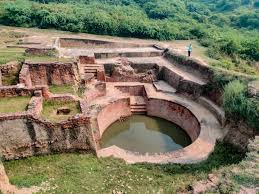
The 1st-century BCE site at Singraur (also known as Sringaverapura) near Allahabad (now Prayagraj), Uttar Pradesh, is significant for revealing early examples of advanced hydraulic engineering. The site showcases an ingenious system for water management, which reflects the technological prowess of ancient Indian civilizations.
- The site features the remains of a large rectangular brick tank, built with careful planning to store water.
- The use of brickwork demonstrates the advanced construction techniques employed, which were capable of supporting such a large structure.
- Water from the River Ganga was channeled into the system, indicating a careful understanding of the region’s natural water sources.
- The water was directed into a silting chamber, designed to remove impurities and sediments, ensuring cleaner water before entering the main tank.
- The silting chamber served an important role in purifying the river water. By allowing sedimentation, it ensured that only clean water would flow into the main tank, preventing clogging and maintaining water quality.
- After passing through the silting chamber, the water would flow into the main tank, which likely served as a reservoir for the surrounding areas.
- This tank would have been used for various purposes, including domestic water supply, agricultural irrigation, or religious rituals.
- The system at Singraur is an early example of advanced hydraulic engineering, showcasing the ingenuity of ancient Indian civilizations in managing water resources effectively.
- The use of a silting chamber indicates a sophisticated understanding of water filtration and purification techniques, which would have contributed to the health and well-being of the local population.
- The integration of the River Ganga into the water management system underscores the importance of rivers in ancient Indian culture, not only as sources of water but also as sacred entities.
- The site of Sringaverapura is believed to have been an important center during the time of the Maurya and Shunga empires, with religious and cultural significance.
- The hydraulic system reflects the advanced urban infrastructure that supported the thriving settlements along the Ganga River, contributing to agricultural productivity and the growth of the local economy.
The discovery of the rectangular brick tank at Singraur offers valuable insights into the ancient Indian approach to water management, further emphasizing the region’s role as a pioneer in hydraulic engineering.